
october 2025
iNCREASiNG ADOPTiON ViA PRODUCT CLARiTY & LEVERAGED TRUST
Exploring the intricate considerations that have to be made when positioning a product within a product.
Theme: Product & Brand
Role: Product Design, Marketing collateral
Timeframe: 6 months
Context
When Ping was first launched by Trade Me in 2017, it was positioned as a stand-alone product that could, in-future, be used by other merchants. Card and direct debit payments could be processed instantaneously, giving both buyers and sellers the peace of mind needed to progress with the trade. Ping also offered the concept of a digital wallet, which aims to create a circular ecosystem of money movement within Trade Me. You sell with Ping, you buy with Ping balance.
Ping was initially introduced as an optional Payment method, but due to the lack of proper user onboarding at its launch, led to users quickly dismissing it as an option.
As it became mandatory for Ping to be a payment option across all listings, we needed to ensure buyers understood what Ping was and how it worked to make trading for both buyers and sellers a more seamless experience.
Problem
Card payments generally aren't an unpopular payment method, especially on an e-commerce platform. However, buyers didn’t understand what Ping was or how it related to Trade Me. It was widely perceived as an unfamiliar third-party product, which led to apprehension to adopt this payment method. It was difficult for buyers to make the connection between Ping and card payments on Trade Me.
The unequal weighting of how each payment option is presented, makes it feel like Trade Me is pushing Ping onto buyers, potentially misaligning with what the user wants

The absence of the Ping logo is a missed opportunity for a brand moment

Why this mattered
With no fallback online payment methods that enabled buyers to pay instantly, confusion around Ping directly impacted conversion, trust, and platform retention.
Put simply, if buyers prefer to pay online but don't know that Trade Me has an online payment option, they won't bother browsing Trade Me.
Approach
I owned the end-to-end payments experience across buyer and seller journeys.
To tackle these problems appropriately, I:
Led discovery into trust gaps and user perception (e.g. why are buyers apprehensive to use Ping?)
Mapped end-to-end payment journeys to identify breakdowns (e.g. how does a buyer experience using Ping from start to finish?)
Defined product and experience opportunities (e.g. how could we introduce Ping better?)
Collaborated with Brand and Marketing to align positioning (e.g. could we change how Ping is perceived as a brand to obtain user trust?)
To understand how users currently perceived Ping, I got together with one of our Research Operations specialists to construct a survey. This survey was sent out to a big pool of users and we were surprised to receive a very high response rate. Some of the findings verified our previous findings, e.g. users don't understand how Ping works. Some findings were new to us, e.g. users didn't understand Ping belongs to Trade Me.
I used these findings to create end-to-end journey maps for buyers and sellers. This would help me identify where exactly the pain points lie and where there was opportunity to improve the user experience. Looking at both the buyer's and seller's perspectives helped me understand where the user experience between traders falls short.
To understand how the overall payment experience could be improved for buyers, I looked at how other products create their payment experiences. I specifically looked at how products handle the concept of a digital wallet.
At the same time, we consulted with our brand specialist and marketing teams to understand if there was something we could change about how users perceive Ping as a brand.
Solution
We knew the problem had to be addressed from various angles, which meant the solution was made up of different parts all led by different business units.
To address lack of trust in Ping as a brand and product, we aligned Ping's branding with Trade Me's brand, to leverage the trust users already had in Trade Me. This meant changing Ping's brand colours and its primary logo.
To address the knowledge, awareness and onboarding problem, we came up with a marketing strategy which aimed to prime users by reinforcing buyer benefits of using Ping. The final output was a video which was used in advertising spots on Facebook and Instagram. My involvement included creating digital assets used in the video to support the storyline. These assets were intentionally designed to be a simpler version of the actual product experience, surfacing key elements instead of recreating the experience 1:1, as these assets were only shown in a few frames.

Solution
What changed for users?
Ping was designed to feel like a native part of Trade Me, not a separate system
The payment experience was more aligned with user intent
Buyers understood that Trade Me offers card payments
Sellers had greater confidence navigating and trading with Ping
Overall trust in Trade Me handling card payments increased
What I intentionally didn’t do
Did not design the solution to the dream future state/long-term roadmap, and instead added stepping stones to get us to this future state faster
Did not rely on branding alone to build trust
Did not reinvent the entire card payment system

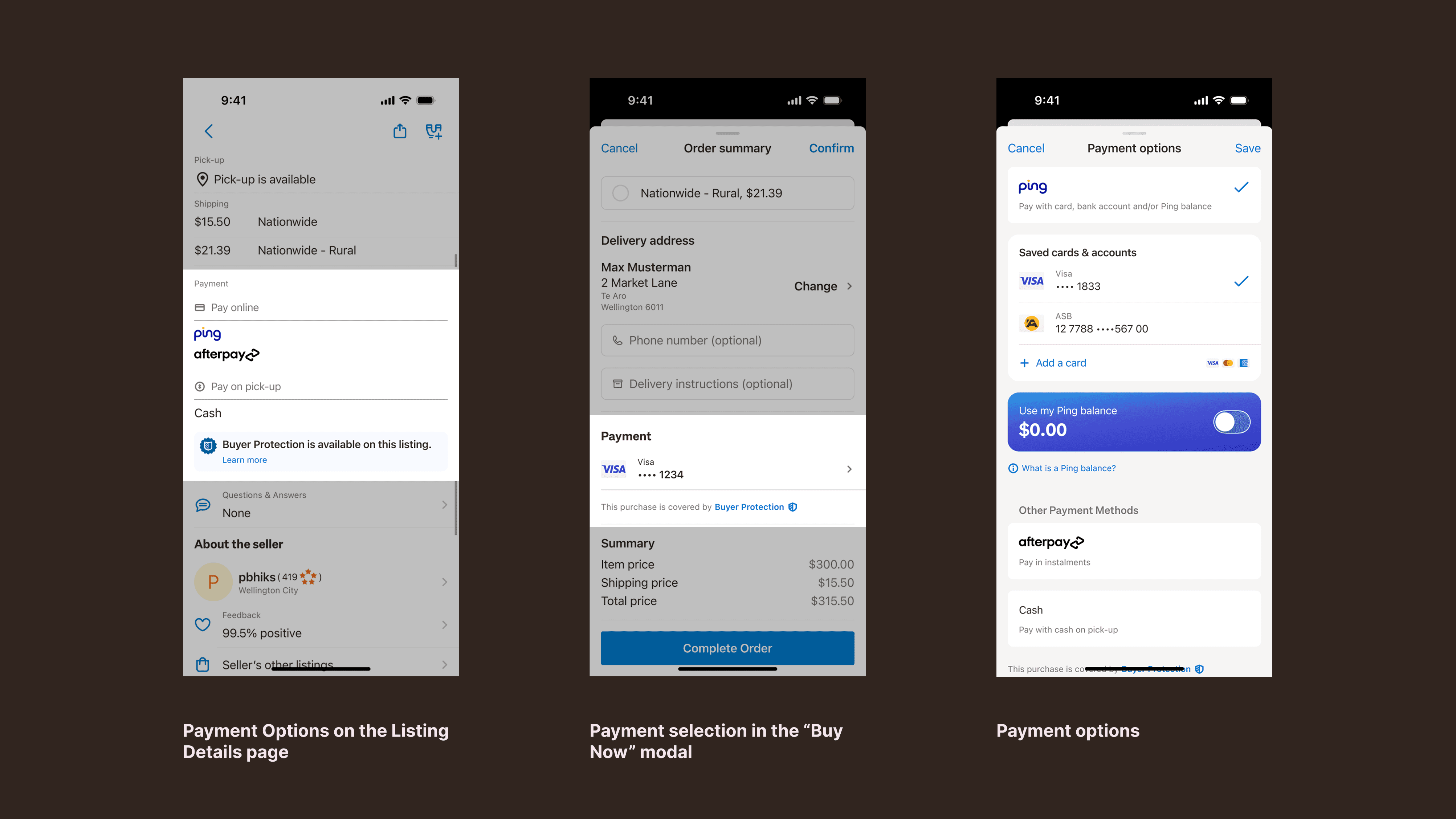
Designing for trust

Repositioned Ping as a Trade Me product by pre-selecting it as the default payment method
Simplified the payment UI to be more in-line with industry standards
Utilised brand colours to highlight features unique to Ping and Trade Me

Used brand assets to communicate clearly how and when Ping is part of the payment process
Designing for clarity

Introduced clearer grouping and terminology, aligning descriptive copy with how the buyer would want to proceed with the trade
Leveraged familiarity via well established card logos to support feature education

Provided access to more information when needed
Designing for adoption

Connected dynamic buyer protection messaging directly to payment choice
Outcome & impact
Increased clarity and trust in how payments work on Trade Me
Reduced friction in both buyer and seller journeys
Increased buyer preference for Ping payments
Supported successful rollout of Ping as a mandatory payment method
key takeaway
Trust in a product isn’t built through branding alone. Trust comes from making the system legible, consistent, and clearly aligned with user expectations.